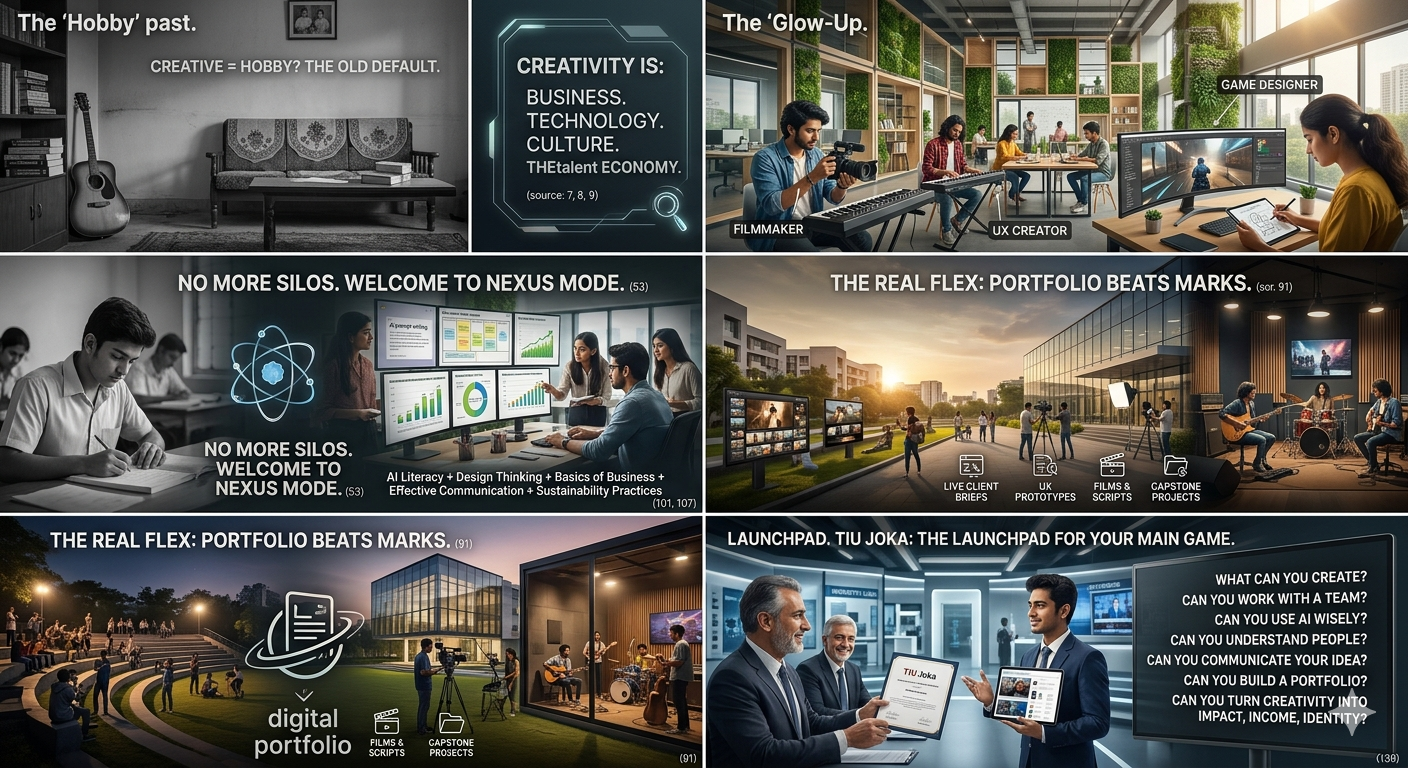
For a long time, Indian families had one default question: “Beta, doctor, engineer, MBA, or government job?” Anything creative was treated like a hobby. Music? Hobby. Dance? Hobby. Writing? Hobby. Film? Risky. Design? Maybe after everything else fails.
That world is over.
Today, creativity is not only art. It is business. It is technology. It is communication. It is culture. It is content. It is gaming. It is brand building. It is immersive experience. It is entrepreneurship. It is India’s next big talent economy.
A creative career today can mean becoming a filmmaker, musician, theatre-maker, dancer, visual artist, writer, curator, content strategist, brand communicator, journalist, game designer, UX creator, entertainment producer, digital marketer, AI-assisted storyteller, XR experience designer, event creator, social media strategist, or creative entrepreneur.
This is not a “Plan B” career. For the right student, this is the front row.
The Glow-Up: What Is A Creative Career Today?
A creative career is any profession where imagination, storytelling, design, communication, aesthetics, technology and human insight come together to create value.
That value may be emotional, cultural, commercial, social, educational or digital. A film can move people. A campaign can build a brand. A game can create a new world. A song can travel across platforms. A design can make an app easier to use. A performance can change how people see society. A data-driven story can expose truth. A festival can build tourism. A digital experience can sell a product.
The creative economy is not one road. It is a whole city.
At one end are classical and performing arts: dance, theatre, music, acting, direction, choreography, composition, cultural practice and storytelling. At another end are communication and media careers: journalism, brand communication, MarTech, public affairs, corporate communication, entertainment business, OTT production, gaming, transmedia storytelling and creator economy. Then comes the high-tech creative zone: digital media, immersive technology, game development, AR, VR, XR, UI/UX, AI-driven content, virtual production and interactive media.
The attached TIU Joka programme notes clearly show this convergence. The Faculty of Creative Professions brings together Performing Arts, Music and Arts, while the Faculty of Communication & Entertainment connects digital communication, entertainment production, strategic communication and journalism. The DMIT blueprint adds gaming, XR, immersive media and AI-enabled content into the same future-facing creative ecosystem.
Who Is This For? Not Everyone. But Maybe You.
Creative careers are best suited for students who do not want to only memorise answers. They want to make things.
They are for the student who watches a film and asks, “How was this shot?” The student who listens to a song and feels the arrangement. The student who writes late at night. The student who notices colour, space, fashion, movement, rhythm, words and mood. The student who loves YouTube but also wants to understand audience analytics. The student who makes reels but wants to become a serious content strategist. The student who games but wants to design worlds. The student who performs in school events and secretly feels alive on stage.
But talent alone is not enough. The creative world rewards disciplined talent. You need imagination, yes. But also punctuality, teamwork, research, business sense, communication, stamina, ethics and the ability to take criticism without collapsing.
Right Stage, Right Track
After Class XII, a student can enter undergraduate creative learning through programmes in performing arts, music, visual arts, creative writing, digital communication, entertainment production, design, media or immersive technology. This is the best stage to build foundation, personality, portfolio and professional discipline.
After graduation, students can go deeper through postgraduate programmes in strategic communication, convergent journalism, entertainment production, media management, creative entrepreneurship or specialised design and technology fields.
Working professionals can also enter through shorter certificates, executive programmes and weekend formats, especially in AI tools, digital marketing, storytelling, communication, content production, event management, creator business and brand strategy.
The point is simple: creative learning is not one age-bound track. But the earlier you start building your portfolio, the stronger your career launch becomes.
Why Creative Learning Is Suddenly So Hot
Because the world has changed.
Earlier, creative work needed access to studios, publishers, channels, labels or production houses. Now, a student with a phone, editing tools, AI support, platform understanding and a strong idea can publish, promote, test and monetise creative work.
But that does not mean everyone becomes successful. In fact, the opposite is true. Since everyone can create, the market now rewards those who can create professionally.
That means knowing the craft. Knowing the platform. Knowing the audience. Knowing the business. Knowing the ethics. Knowing how to pitch. Knowing how to build a portfolio. Knowing how to use AI without becoming lazy. Knowing how to work in teams. Knowing how to convert ideas into finished work.
This is why creative learning is now a serious domain. It has multiple possibilities: employment, freelancing, entrepreneurship, studio work, agency work, consulting, content ventures, cultural organisations, media houses, production companies, gaming studios, OTT ecosystems, NGOs, festivals, galleries, museums, startups and global remote work.
No More Silo Learning. Welcome To Nexus Mode.
The biggest mistake in creative education is to teach one skill in isolation.
A dancer who does not understand digital distribution loses visibility. A musician who does not understand streaming economics gets exploited. A writer who cannot pitch remains unpublished. A designer who does not understand business may create beautiful but useless work. A journalist without data literacy is incomplete. A filmmaker without budgeting sense can crash a project. A game designer without psychology may build boring experiences.
That is why the Nexus foundation is so important.
A serious creative learner today must build five foundational literacies together: AI Literacy, Design Thinking, Basics of Business, Effective Communication and Sustainability Practices.
This is not extra decoration. This is the base engine.
AI Literacy: Your Creative Co-Pilot, Not Your Replacement
AI is already changing writing, editing, music production, design, animation, journalism, advertising, gaming, research and audience analysis. Students who ignore AI will fall behind. Students who blindly depend on AI will become average. The winners will be those who use AI intelligently.
AI literacy means understanding prompt writing, AI-assisted ideation, content workflows, data dashboards, image and video generation, bias, hallucination, deepfakes, copyright, ethics and authenticity. The attached programme notes repeatedly treat AI as a live professional tool, not an add-on workshop. In the communication programmes, AI-driven workflows, analytics, algorithmic awareness and AI ethics are embedded as professional competence.
Design Thinking: Don’t Just Make. Solve.
Design thinking teaches students to start with people. Who is the audience? What is their pain point? What do they feel? What do they need? What experience are we creating?
This is crucial for every creative profession. A theatre piece needs audience empathy. A campaign needs consumer insight. A game needs player psychology. A UI/UX project needs user testing. A social impact film needs community understanding.
Design thinking builds the habit of empathising, defining, ideating, prototyping, testing and improving. It turns raw imagination into usable innovation.
Business Basics: Art Also Needs A Revenue Model
Many creative people fail not because they lack talent, but because they do not understand money.
Creative students need to learn pricing, contracts, intellectual property, copyright, taxation basics, invoicing, personal branding, client handling, pitch decks, platform monetisation, sponsorship, grants, budgeting and entrepreneurship.
The Faculty of Creative Professions notes place business, freelance and gig economy basics across all eight semesters through CASD modules, covering contracts, pricing, taxation, platforms and personal branding. That is exactly the kind of real-world training creative students need.
Effective Communication: Talent Must Be Explained
A great idea badly presented often dies.
Creative professionals must speak, write, pitch, present, defend and document their work. They need artist statements, showreels, portfolios, programme notes, proposals, scripts, campaign decks, research summaries and client presentations.
Communication is not only English fluency. It is clarity of thought. It is persuasion. It is storytelling. It is confidence. It is the ability to say, “This is my idea, this is why it matters, this is how it works, and this is what value it creates.”
Sustainability Practices: Future Creators Cannot Be Careless
The next generation of creative professionals must understand ecological and social responsibility.
Events must become greener. Production must reduce waste. Fashion, design, theatre, exhibitions, media campaigns and entertainment must think about materials, energy, inclusion, representation, ethics and community impact.
Sustainability is not boring. It is future style. It gives creative work responsibility and depth. A student who understands sustainability can design better events, better stories, better campaigns and better cultural projects.
The Real Flex: Portfolio Beats Marks
In creative careers, marks matter. But finished work matters more.
A student must graduate with proof: films, scripts, campaigns, performances, compositions, exhibitions, articles, digital products, prototypes, games, UX projects, research papers, live client work, internship outputs, social impact projects and capstone projects.
That is why portfolio-based training and evaluation is a game changer. The FCE notes make portfolio culture a non-negotiable requirement, with every graduate exiting with a professionally formatted digital portfolio. The same notes emphasise studios, newsrooms, agency simulations, production labs and live client briefs, where every semester is anchored in making, pitching, producing and reviewing real work.
This is how creative education should work. Not “write an exam and forget.” But “make, test, show, improve, publish, perform, pitch, reflect.”
India Needs T-Shaped Creative Professionals
India does not need narrow degree-holders who can do only one thing. India needs T-shaped professionals: broad enough to understand many connected fields, and deep enough to execute one domain seriously.
A media student should understand AI, data, design, ethics and business. A music student should know performance, production, copyright and digital platforms. A game student should know coding, narrative, psychology, UX and monetisation. A film student should know script, production, finance, technology and distribution.
The DMIT blueprint identifies exactly this gap: traditional degrees often create a “skill convergence deficit,” where a designer may not code, a computer science graduate may not build a game narrative, and a digital marketer may not design user experience. Its proposed solution is “Skilltelligence”: the fusion of skill and adaptive intelligence across design, technology, behavioural thinking, production and AI resilience.
That is the future.
Why 24×7 Residential Creative Learning Makes Sense
Creative learning cannot be fully done in a 10 a.m. to 4 p.m. classroom model.
A dancer needs rehearsals. A theatre group needs night practice. A film team needs shoots, edits and screenings. A band needs jam sessions. A writer needs workshops. A game team needs testing. A campaign team needs brainstorming. A design team needs prototyping. A journalist needs newsroom drills. An event team needs setup, execution and review.
This is why a residential campus is ideal for creative learning.
When students live, learn, rehearse, produce, debate, fail and rebuild together, learning becomes a lifestyle. The campus becomes a living studio. Classrooms become labs. Hostels become idea zones. Evenings become practice time. Weekends become production time. Festivals become live assignments. Campus problems become design challenges. Community projects become fieldwork. Industry mentors can come for masterclasses, juries and critiques.
A residential creative campus can create the one thing YouTube tutorials cannot: an ecosystem.
What Makes This Approach Unique?
The uniqueness lies in the combination.
First, it is multidisciplinary. A student does not enter a narrow tunnel. The student begins with broad Nexus learning, then moves into domain immersion, then specialisation, then capstone launch.
Second, it is AI-integrated. AI is not treated as a fear or gimmick. It is treated as a tool, with ethics.
Third, it is business-aware. Students learn how creative work survives in the market.
Fourth, it is communication-heavy. Students learn to pitch, present and publish.
Fifth, it is sustainability-linked. Creative work is connected to society and planet.
Sixth, it is portfolio-first. Students are judged by what they can actually make.
Seventh, it is India-rooted but globally aware. Indian aesthetics, storytelling traditions, music, theatre, regional languages, media histories and cultural practices can sit alongside AI, XR, OTT, gaming, brand strategy and global creative tools.
That mix is powerful.
TIU Joka: Why This Campus Can Become The Launchpad
The TIU Joka Residential Campus is useful because it has the right idea at the right time: a School of the Future built around Nexus learning, industry integration and experiential education. The attached programme documents position Joka not as a conventional campus, but as a residential, practice-led, AI-integrated, industry-linked academic ecosystem across creative professions, communication, entertainment and immersive technology.
For a young Indian student who wants to build a serious creative career, this matters.
Because the future will not ask, “How many notes did you memorise?”
It will ask:
What can you create?
Can you work with a team?
Can you use AI wisely?
Can you understand people?
Can you communicate your idea?
Can you build a portfolio?
Can you turn creativity into impact, income and identity?
That is the real exam.
And creative learning, done the right way, can help students pass it with style.