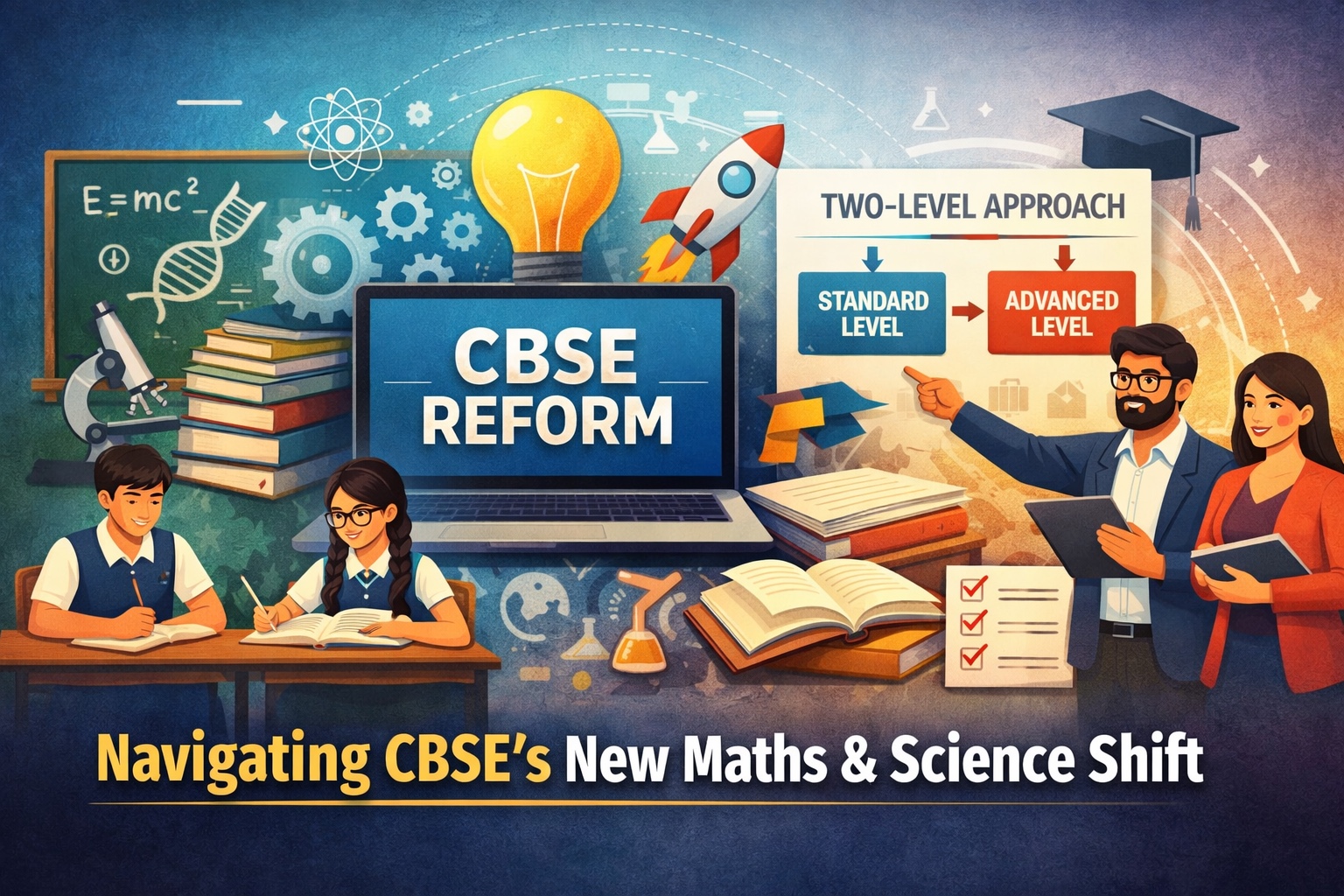
The Central Board of Secondary Education (CBSE) is gearing up for a major change in its academic structure from the 2026–27 session. Aligned with the vision of the National Education Policy (NEP) 2020 and the National Curriculum Framework (NCF) 2023, this shift moves away from rote learning and focuses more on a practical, understanding-based approach. With special emphasis on Mathematics and Science, the new system encourages students to think critically, build strong conceptual clarity, and apply knowledge in real-life situations. Overall, it reflects a conscious effort to prepare students for a fast-changing, technology-driven world.
A key highlight of this reform is the introduction of the “two-speed” or two-tier system in Mathematics and Science from Class 9 onwards. Under this model, all students will study a standard level curriculum, while those who wish to explore subjects in greater depth can opt for an advanced level assessment focusing on higher-order thinking skills. This flexible approach is designed to accommodate diverse learning abilities, reduce academic pressure, and allow students to align their studies with their future academic and career goals.
However, the transition to this new system presents several challenges for schools. One of the most pressing concerns is addressing learning gaps that may arise as students move from traditional rote-based learning to a more conceptual and analytical framework. Differences in student preparedness, along with confusion among parents regarding subject levels, require schools to adopt structured support systems such as diagnostic assessments, bridge courses, and remedial teaching strategies. Effective communication and planning will be essential to ensure a smooth transition.
In this evolving educational landscape, digital learning platforms are playing a crucial role in supporting educators and school leaders. The Ekluvya channel, through its dedicated playlist on CBSE reforms, provides a comprehensive guide for navigating these changes. The playlist is specifically designed to help school leaders understand and implement the new Maths and Science framework, focusing on managing “two-speed” subjects, addressing learning gaps, and aligning teaching strategies with competency-based learning.
What makes the Ekluvya channel particularly valuable from an educational perspective is its ability to translate complex policy changes into practical, actionable strategies. Rather than merely explaining reforms, the content emphasizes implementation, guiding schools on how to adapt classroom practices, support teachers and ensure student readiness. This makes it a useful reference not only for administrators but also for educators seeking clarity on the new system.
One of the most significant takeaways from the playlist is the concept of a “60-day academic readiness plan.” This structured approach outlines a phased strategy for effective transition, beginning with assessing student learning gaps, followed by adapting teaching methodologies, and finally focusing on implementation through continuous evaluation and targeted support. Such a systematic plan ensures that schools can gradually align with reforms without overwhelming students or educators.
Teacher preparedness remains another critical factor in the success of these reforms. With the shift towards application-based learning, educators are expected to adopt innovative pedagogical methods, integrate real-life examples, and promote critical thinking. In this regard, platforms like the Ekluvya channel act as supplementary learning resources, helping teachers stay informed and confident in their approach to the evolving curriculum.
Beyond Mathematics and Science, the CBSE reform reflects a broader move towards holistic education. With increased emphasis on skill development, interdisciplinary learning, and emerging fields like Artificial Intelligence and Computational Thinking, the system is becoming more aligned with global education standards. The growing weightage of competency-based questions further encourages students to focus on understanding rather than memorization.
In conclusion, the upcoming CBSE reforms represent a transformative phase in Indian education. While the shift demands careful planning and adaptation, it also opens up opportunities for flexible, meaningful, and future-ready learning. Resources such as the Ekluvya channel’s playlist play a crucial role in bridging the gap between policy and practice, enabling school leaders and educators to navigate this transition with clarity, preparedness, and confidence.
Acknowledgement & Sources
This article draws upon insights from the Ekluvya playlist on CBSE Maths and Science reforms, along with official updates from the Central Board of Secondary Education, and key policy documents including the National Education Policy (NEP) 2020 and the National Curriculum Framework (NCF) 2023. Additional context has been referenced from educational reports and coverage by reputed platforms such as Times of India and NDTV, as well as CBSE teacher training and implementation guidelines.