
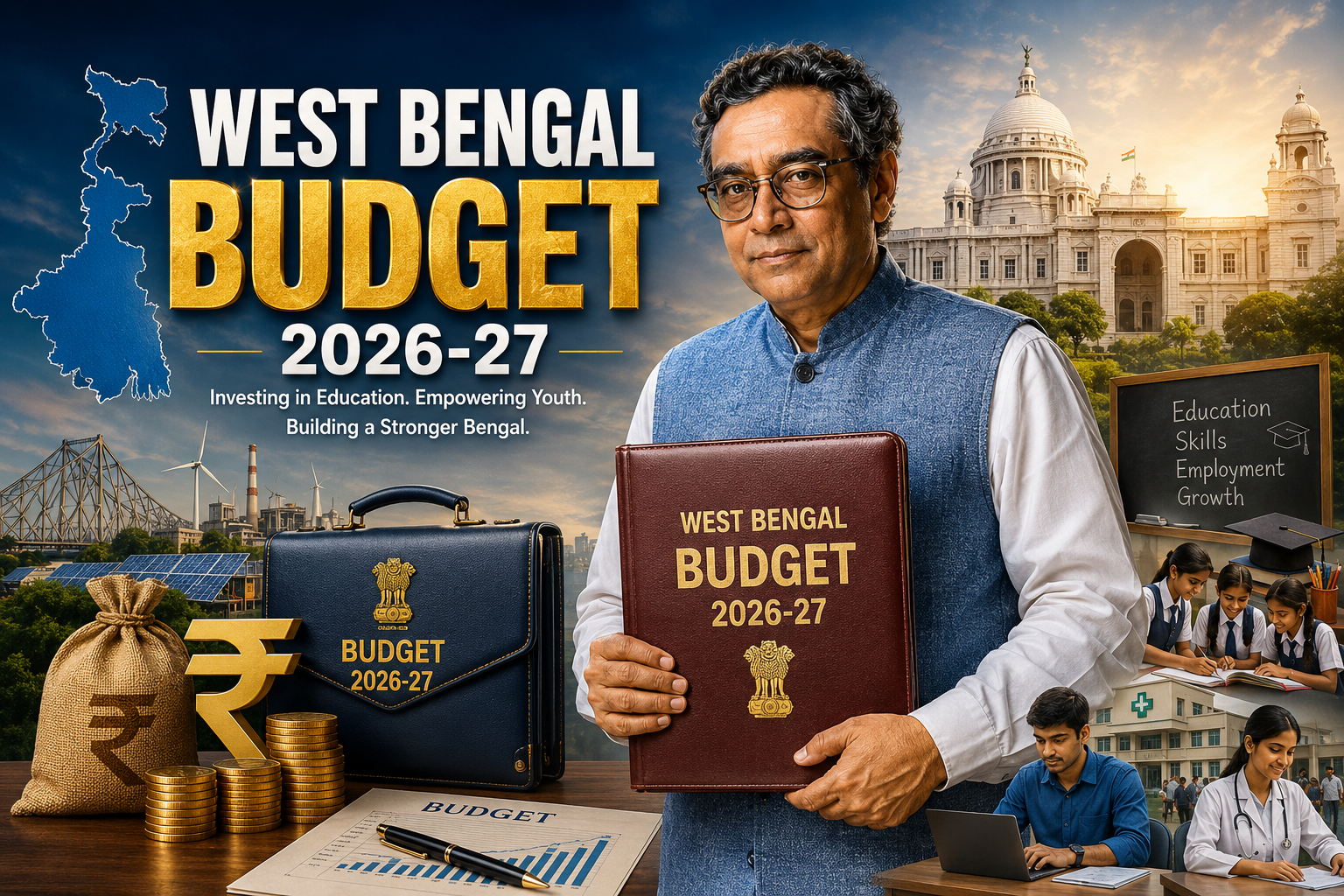
In a landmark moment for West Bengal, Finance Minister Swapan Dasgupta presented the BJP government’s first full budget for the financial year 2026-27 in the State Assembly on June 22, 2026. Operating under the visionary theme of “Viksit Bangla, Viksit Bharat”, the budget outlines an ambitious ₹4.38 lakh crore (₹4,38,775.29 crore net) expenditure plan, and education sits firmly at its heart.
From establishing world-class institutions like an IIT and an IIM in North Bengal, to offering ₹50,000 scholarships for girl students, and filling 50,000 teaching vacancies, this budget signals a comprehensive overhaul of the state’s education ecosystem. Here is a detailed look at every education-related announcement.
Higher Education: World-Class Institutions Come to North Bengal
One of the most headline-grabbing announcements in this budget is the proposal to establish an IIT (Indian Institute of Technology) and an IIM (Indian Institute of Management) in North Bengal. For decades, North Bengal has lagged behind the southern districts in terms of access to premier higher education. This move, if executed well, could transform the region into an educational hub and significantly reduce the brain drain that has long plagued its youth.
Complementing this is the establishment of a Tribal University in Jhargram, a deeply meaningful step towards inclusive education that recognizes the unique cultural and academic aspirations of tribal communities in the Jangalmahal region.
Additionally, new women’s colleges are set to be established across the state (with reports pointing to women’s universities in Contai, Kaliachak and Falta), further widening access to higher education for women, particularly in semi-urban and rural areas.
PM Shri Schools: ₹2,100 Crore for School Infrastructure
At the school level, the budget allocates a substantial ₹2,100 crore for PM Shri Schools across West Bengal. PM Shri (Prime Minister Schools for Rising India) are model schools designed to deliver high-quality, equitable, and inclusive education aligned with the National Education Policy (NEP) 2020. This allocation marks one of the most significant investments in school-level infrastructure in recent years and is expected to transform hundreds of schools across the state.
Kendriya Vidyalayas in Jhargram: Two New Schools Announced
The budget announces the establishment of two Kendriya Vidyalayas in Jhargram, alongside the Tribal University in the same district. Kendriya Vidyalayas are centrally funded schools known for their consistent academic quality and pan-India curriculum, and their presence in Jhargram, a historically underserved tribal belt, marks a significant step towards educational equity in that region.
Mid-Day Meal Scheme: Enhanced Nutrition for Students
Recognizing that good education begins with good nutrition, the budget proposes to raise the mid-day meal allocation per student to ₹10, a much-needed revision to account for rising food costs. Notably, ISKCON has been brought on board to assist in food preparation and distribution, ensuring quality and scale. The monthly remuneration of mid-day meal cooks is also being raised by ₹1,000, acknowledging their essential role in the scheme.
Scholarships & Financial Assistance: Empowering Students
The state budget introduces a robust financial support framework designed to widen access, reduce dropout rates, and ensure no student has to leave education due to financial constraints:
₹50,000 one-time support provided to unmarried female students upon admission to government and government-aided colleges, serving as a powerful incentive to keep girls in higher education.
The budget also introduces Bharosa Karmosuchi, a youth welfare initiative aimed at supporting employment and competitive examination aspirants. While financial assistance for eligible candidates has been proposed, detailed eligibility criteria and implementation guidelines are expected to be released separately.
Together, these measures reflect a strong commitment to widening access, reducing dropout rates, and ensuring no student has to leave education due to financial constraints.
Sanitary Vending Machines in Colleges
In a progressive step towards menstrual hygiene and dignity, the budget announces the installation of sanitary vending machines in educational institutions across the state. This seemingly small step carries significant weight, ensuring that female students have access to sanitary products on campus, reducing absenteeism and promoting well-being.
Women in Education: A Budget-Wide Commitment
Among the most significant announcements for the education sector is the government’s commitment to large-scale public sector recruitment as part of its plan to fill 1 lakh government vacancies, with 33% reservation for women. The move is expected to strengthen educational institutions through fresh appointments while addressing longstanding concerns around staffing and recruitment. Given West Bengal’s prolonged controversies and legal challenges surrounding teacher recruitment, the announcement signals an intent to restore confidence in the system and accelerate workforce renewal across the state.
Strengthening the Education Support Ecosystem
The budget also brings significant financial relief to the frontline workforce that sustains West Bengal’s education and child development ecosystem. Para-teachers in state-run schools will receive a monthly remuneration increase of ₹5,000, while Anganwadi and ASHA workers will also see their monthly earnings rise by ₹5,000. These measures reflect the government’s recognition of the critical role played by educators, caregivers, and community health workers in strengthening learning outcomes, child welfare, and public health delivery across the state.
Bengal AI Mission: Technology Meets Education
In an era defined by artificial intelligence, the budget announces the launch of the Bengal AI Mission, a state-level initiative to drive AI adoption across sectors, including education. This is a forward-looking step that positions West Bengal as a state ready to embrace the technological future. To support the digital economy and emerging careers, the government also plans to establish 500 Content Creator Labs across the state.
In tandem with this, ₹50 crore has been earmarked for the upgradation of Sanskrit College – one of the oldest and most distinguished institutions in the country, to promote Sanskrit language, literature, and classical studies, striking a balance between heritage and modernity.
Sports Education & Youth Development
The budget also places a strong emphasis on strengthening West Bengal’s sports ecosystem through a series of infrastructure and talent-development initiatives. A dedicated Sports University is proposed to create structured academic and training pathways for aspiring athletes, while an international-standard stadium in North Bengal aims to enhance the region’s sporting infrastructure. To promote access to quality sports facilities at the grassroots level, the government plans to construct mini indoor stadiums in Assembly constituencies across the state at a cost of ₹5 crore each.
In addition, sports clubs participating in national-level competitions will receive financial assistance of ₹1 crore each, and ₹20 crore has been earmarked for Khelo India activities in West Bengal. Together, these initiatives reflect a commitment to nurturing sporting excellence, expanding opportunities for young talent, and integrating sports more closely with education and youth development.
The Bigger Picture
This budget represents a definitive shift in West Bengal’s education policy, from reactive crisis management to proactive institution building. The combination of world-class institutions (IIT, IIM, Tribal University), massive teacher recruitment, student financial aid, school infrastructure investment (PM Shri Schools) and technology integration (Bengal AI Mission) creates a multi-layered, ambitious education agenda.
For a state that has historically produced some of India’s greatest thinkers, scientists, and educators, this budget could mark the beginning of a genuine educational renaissance, one grounded in equity, excellence, and opportunity for all.
Acknowledgement
This article was researched and compiled by the editorial team at Techno Times based on live budget announcements made in the West Bengal Legislative Assembly on June 22, 2026, by Finance Minister Swapan Dasgupta. Information has been sourced from official Assembly proceedings and leading news publications including India TV News, The Tribune, India.com, ANI, Oneindia, and StudyIQ. Techno Times acknowledges the West Bengal Finance Department for the detailed budget disclosures that made this report possible.
All figures mentioned are as announced in the Budget Speech for FY 2026-27. Actual implementation and final allocations may be subject to Assembly approval and policy revisions.