
Techno India University, West Bengal, has achieved a significant milestone in the field of research and innovation with the sanctioning of a prestigious CARS (Contract for Acquisition of Research Services) project by the Integrated Test Range (ITR) under the Defence Research & Development Organisation (DRDO), Chandipur, Odisha. The project titled “Design and Development of Algorithms for Deep Learning based Range Estimation (DLRE) using Single IR Camera View of EOTS (DLRE-EOTS)” has been formally approved and forwarded for implementation. This project represents a major step forward in strengthening TIU’s involvement in high-impact defence research and advanced technological development.
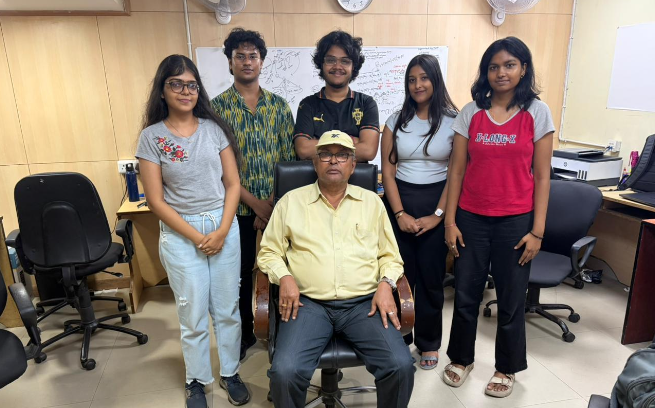
The project is being led by Prof. (Dr.) Debasis Chaudhuri from the Department of Computer Science and Engineering at TIU as the Principal Investigator, with Prof. (Dr.) Jayant Poray serving as the Co-Principal Investigator. The research team also includes Project Scientist Mr. Akash Samanta from the CSE-AI domain, along with student researchers Mr. Mriganka Debnath, Miss Pragya Vidyanand Sah, Miss Richa Jha, and Miss Saloni Agarwal. These students are also associated with projects under the DRDO Young Scientist – Cognitive Technology Lab, Chennai, further reflecting the depth of collaboration between academic institutions and national research organizations.
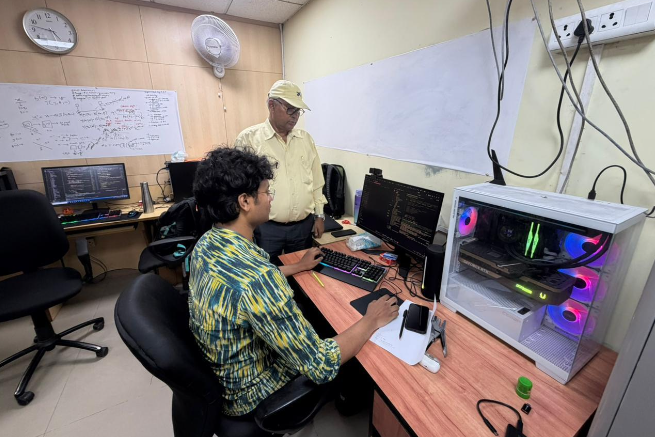
The research focuses on one of the most crucial aspects of modern defence systems – missile tracking and range estimation. In contemporary defence and surveillance operations, accurate missile tracking is essential for national security, enabling early threat detection, trajectory prediction, efficient interception, and real-time intelligence gathering. Existing systems rely on multiple sensors such as radar, infrared systems, and satellites to determine a missile’s position, speed, and potential target. However, a major limitation arises when only a single Electro-Optical Tracking System (EOTS) is used, as it provides only two-dimensional angular data – azimuth and elevation – without direct depth information, making accurate range estimation extremely challenging.
Addressing this limitation, the TIU-led project aims to develop a deep learning-based artificial intelligence model capable of estimating the range of a target using data from a single infrared camera. The innovation lies in creating a passive ranging system that can analyze video frames, learn target characteristics, and predict the distance of the object without relying on triangulation or multiple sensor inputs. This approach not only enhances efficiency but also improves stealth capabilities, as the system operates without emitting signals. By transforming limited 2D visual data into meaningful range estimations, the project seeks to redefine how single-sensor tracking systems function in defence scenarios.
This achievement highlights Techno India University’s growing prominence in advanced research, particularly in the domains of artificial intelligence and defence technology. By contributing to advancements in passive tracking systems and intelligent surveillance mechanisms, TIU is reinforcing its role as a key player in bridging academia and national security innovation. The project not only showcases the expertise of its faculty and students but also strengthens its collaboration with premier organizations like DRDO, paving the way for future research opportunities and technological breakthroughs.
Overall, the DRDO-sanctioned CARS project stands as a testament to TIU’s commitment to excellence in research and its dedication to contributing meaningfully to national development through innovation and scientific advancement.