
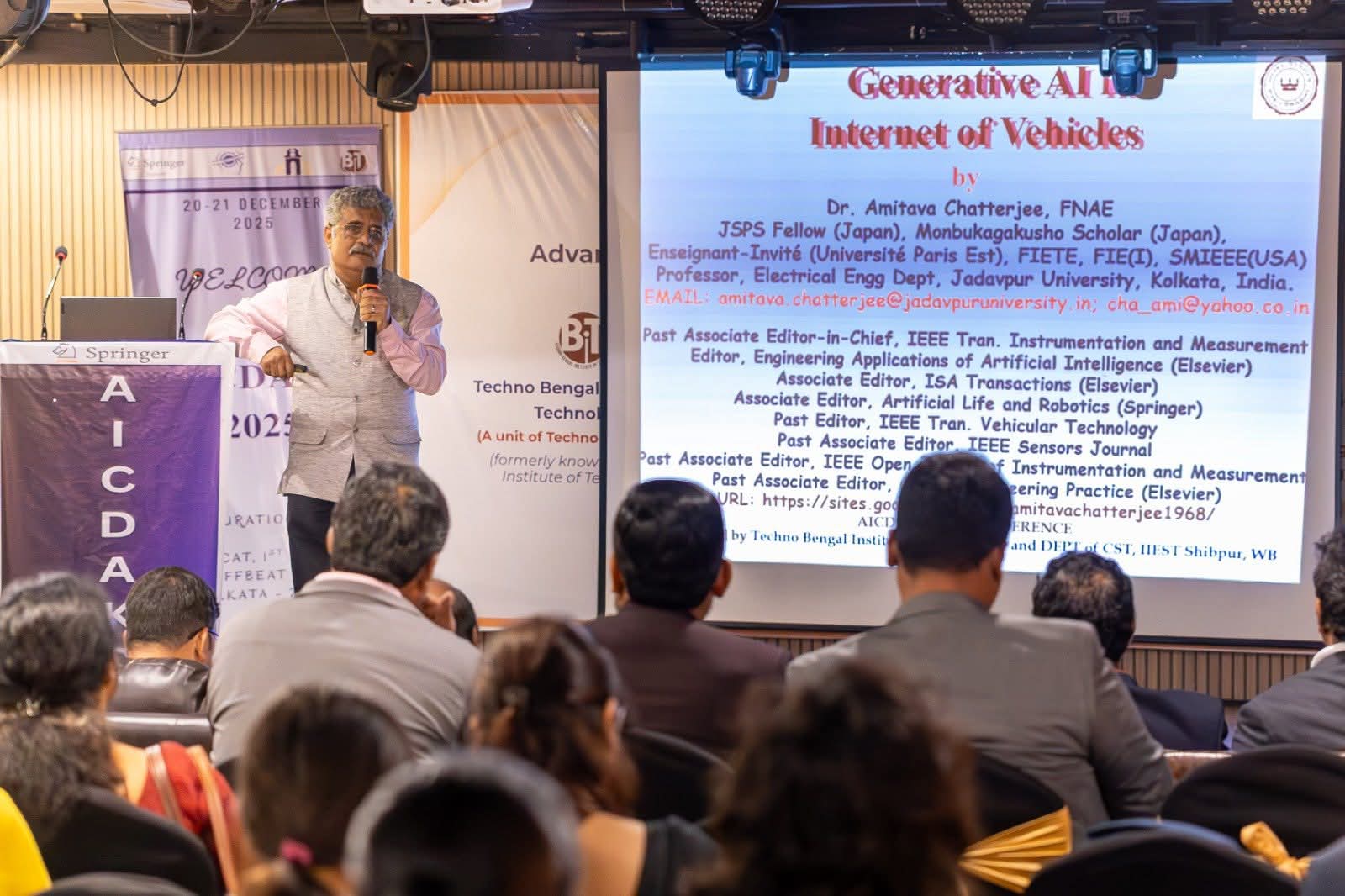
The evolving relationship between artificial intelligence and modern transportation took center stage at AICDAKD 2025, held on 20–21 December 2025 and conducted by Techno Bengal Institute of Technology in association with IIEST, Shibpur. Among the highlights of the conference was a thought-provoking keynote address by Dr. Amitava Chatterjee on “Generative AI in Internet of Vehicles,” which drew significant attention from researchers, academicians, and students alike.
In his session, Dr. Chatterjee explored the growing impact of generative artificial intelligence — a powerful class of AI capable of creating meaningful data, models, and simulations — and its transformative role within the Internet of Vehicles (IoV). His talk emphasized how the convergence of advanced AI and connected vehicle technologies can reshape the future of mobility, making transportation systems smarter, safer, and more adaptive.
One of the key ideas presented was the use of generative models to produce high-quality synthetic datasets. Such datasets, he explained, can help overcome limitations related to data scarcity and privacy while enabling more robust training of intelligent vehicular systems. By generating realistic driving scenarios and traffic patterns, researchers and engineers can refine algorithms without relying solely on real-world data collection.
Dr. Chatterjee also discussed how generative AI can support real-time predictive decision-making frameworks within IoV networks. From anticipating traffic flow to enabling vehicles to communicate more efficiently with each other and with infrastructure, these technologies can significantly enhance connectivity and safety. His insights highlighted the role of intelligent communication frameworks in minimizing delays, improving coordination among vehicles, and strengthening overall network intelligence.
A notable aspect of the keynote was the focus on future mobility ecosystems. By integrating generative AI with next-generation communication technologies, Dr. Chatterjee illustrated a vision of highly responsive vehicular networks capable of learning, adapting, and securing themselves against evolving challenges. This fusion of AI and communication systems, he suggested, could pave the way for more collaborative and autonomous mobility solutions.
The keynote left participants with a deeper understanding of how emerging AI innovations can redefine transportation research and development. As AICDAKD 2025 brought together diverse perspectives from academia and industry, Dr. Chatterjee’s session stood out as a compelling reminder that the future of vehicles lies not just in hardware advancements, but in intelligent systems that continuously learn and evolve.
Through discussions like these, the conference reinforced the importance of interdisciplinary collaboration in shaping the next era of connected mobility — one where generative intelligence drives innovation beyond traditional boundaries.