
There was a time when “sustainability” sounded like a nice word for seminars, posters, tree plantation drives and annual day speeches. Not anymore. Today, sustainability is business. It is policy. It is technology. It is law. It is finance. It is design. It is communication. It is climate action. It is social impact. It is the future of work.
For young India, this is not just about “saving the planet”. That is important, of course. But sustainability-focused careers are also about building serious professional lives in CSR, ESG, climate-tech, circular economy, green business, social entrepreneurship, environmental data, urban resilience, rural development and impact consulting.
In simple words: the world has a problem-solving crisis. Sustainability careers train you to become one of the problem-solvers.
First, Decode the Buzz: CSR, ESG, Sustainability
Sustainability is the big umbrella. It means creating systems where people, planet and prosperity can survive together. It asks: Can a business grow without destroying nature? Can a city expand without choking people? Can development happen without leaving the poor behind? Can technology help without creating new inequalities?
CSR, or Corporate Social Responsibility, is about how companies contribute to social development. In India, CSR has a legal framework under Section 135 of the Companies Act, Schedule VII and CSR Rules, and eligible companies must plan, disclose and monitor CSR work through board-driven processes.
ESG means Environmental, Social and Governance. It is about how companies perform on climate, waste, energy, labour, diversity, community impact, transparency, board ethics and responsible governance. In India, SEBI’s BRSR and BRSR Core frameworks have made sustainability reporting and assurance a serious corporate responsibility, not just a brochure line.
So yes, sustainability is not “soft”. It is hardcore career material.
What Are Sustainability-Focused Careers?
Sustainability careers are jobs and professions where your work directly connects with environment, society, business responsibility, climate action or development impact.
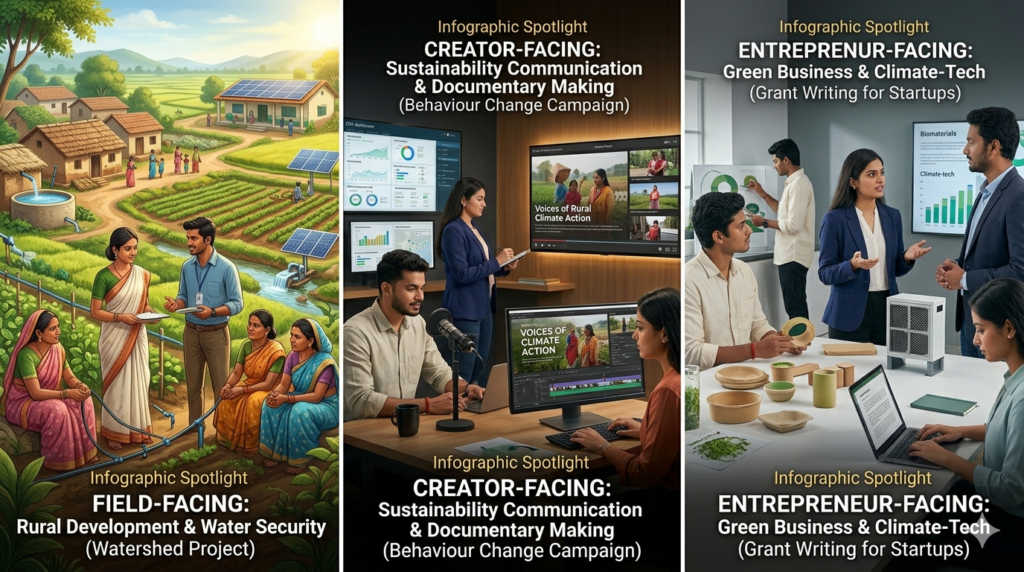
Some roles are corporate-facing: Sustainability Analyst, ESG Associate, CSR Programme Executive, BRSR Implementation Associate, Carbon Accounting Associate, Environmental Compliance Officer, ESG Reporting Executive, Circular Economy Project Associate, Climate Action Programme Associate and Sustainability Consulting Trainee.
Some are field-facing: NGO Sustainability Associate, Community Climate Resilience Facilitator, Livelihoods Project Associate, Watershed and Natural Resource Field Associate, Biodiversity Field Researcher, Urban Slum Development Coordinator, Climate-Smart Agriculture Professional and Community Mobiliser.
Some are creator-facing: Sustainability Communication Specialist, Climate Content Creator, Impact Storyteller, ESG Report Writer, Development Documentary Maker and Behaviour Change Campaign Designer.
Some are entrepreneur-facing: Green Enterprise Founder, Climate-Tech Startup Team Member, ESG Audit Freelancer, Social Entrepreneur, Grant Writer, CSR Strategy Consultant and Independent Sustainability Consultant.
The TIU Joka Faculty of Sustainability and Development proposal lists similar career pathways across professional, social, civic, research, entrepreneurship and gig-work tracks, showing how wide this career ecosystem has become.
Who Is Best Suited for This?
This field is perfect for young people who are not satisfied with “just another job”. It suits students who ask questions like: Why are cities flooding? Why is waste everywhere? Why are villages losing livelihoods? Why are companies suddenly talking about ESG? Why does climate change hit the poor harder? Why do some CSR projects fail even after big money is spent?
You do not have to be a topper in every subject. You need curiosity, empathy, discipline and field-readiness. You must be ready to work with data and people. You must be comfortable in classrooms, labs, villages, boardrooms and digital dashboards.
Science students can move into environmental systems, climate science, GIS, carbon accounting, ecological audits and green technology. Commerce and management students can move into ESG reporting, CSR strategy, green finance, impact measurement and responsible business. Humanities and social science students can move into development studies, policy, advocacy, community work, sustainability communication and social impact.
The best stage to begin is immediately after Class 12 through a serious undergraduate programme. But this field is also open at later stages: after graduation through postgraduate diplomas, after a master’s through research or consulting, and even mid-career through executive learning in CSR, ESG, sustainability reporting and impact management.
Why This Domain Is Suddenly Hot
Because the old growth model is cracking.
Climate change is no longer a future chapter. It is heatwaves, floods, cyclones, crop stress, water shortage, pollution and migration. India’s updated climate direction includes stronger 2035 commitments, including reducing emissions intensity and increasing non-fossil electric power capacity.
Businesses cannot ignore this. Investors are asking questions. Regulators are asking questions. Communities are asking questions. Young consumers are asking questions. Companies now need people who can measure impact, report honestly, reduce risk, manage resources, design projects and communicate with credibility.
India also has a massive CSR ecosystem. Companies need people who understand law, project design, NGO partnerships, community needs, budgets, documentation, monitoring, evaluation and impact storytelling. CSR is no longer only donation management. Good CSR is development strategy.
ESG is even bigger. A company may need to track energy use, water use, emissions, waste, employee safety, gender diversity, supply chain practices and governance quality. This needs trained professionals who understand both numbers and narratives.
That is why sustainability-focused learning is no longer optional. It is a next-gen career engine.
How to Learn for CSR and ESG Professions
Do not learn CSR-ESG like a textbook subject. Learn it like a professional craft.
Start with the basics: sustainability science, climate change, SDGs, environmental law, development challenges, CSR rules and ESG frameworks. Then move to tools: AI-enabled analysis, data dashboards, GIS, impact assessment formats, BRSR reporting templates, carbon accounting basics, project monitoring tools and stakeholder mapping.
Then go to the field. Visit communities. Study a waste system. Audit a campus. Map water use. Interview beneficiaries. Understand how a CSR project actually works after the launch photo is over. Learn why some projects look great on paper but fail on the ground.
Then learn documentation. CSR-ESG professionals write a lot: proposals, impact reports, policy briefs, audit notes, dashboards, case studies, presentations, donor reports and sustainability stories. If you cannot write clearly, you cannot lead in this sector.
Then build a portfolio. Not just marksheets. Real work samples. A waste audit. A carbon footprint estimate. A CSR proposal. An ESG dashboard. A community impact story. A fieldwork diary. A policy brief. A sustainability campaign. A capstone project.
That is what makes you employable.
The Nexus Learning Stack: The Real Superpower
A strong sustainability student cannot learn only environment. That is too narrow. The future belongs to nexus learners.
The must-have foundation is: AI Literacy + Design Thinking + Basics of Business + Effective Communication + Sustainability Practices.
AI Literacy helps students analyse data, build dashboards, summarise field reports, identify patterns, prepare ESG documentation and improve decision-making. But it must be ethical AI, not blind copy-paste.
Design Thinking helps students understand real human problems. A village water project, a plastic waste system or a CSR skilling initiative cannot be designed from an air-conditioned room. You need empathy, prototyping, testing and redesigning.
Basics of Business help students understand budgets, pricing, revenue, compliance, supply chains, contracts, consulting models and entrepreneurship. Sustainability without business sense often becomes idealism without execution.
Effective Communication helps students speak to different audiences: villagers, NGOs, corporate leaders, government officers, investors, teachers, media and students. The same sustainability idea must be explained in different languages, tones and formats.
Sustainability Practices give the ethical and technical backbone: climate literacy, waste systems, circular economy, biodiversity, resource management, ESG, CSR, SDGs and ecological responsibility.
The TIU Joka proposal rightly embeds these cross-cutting competencies structurally, not as side add-ons. It brings AI literacy, CSR and development practice, business basics, sustainability sciences, design thinking, communication, entrepreneurship and national-global exposure into one learning architecture.
Why the TIU Joka Approach Looks Different
The strongest part of the TIU Joka model is that it does not treat sustainability as one subject. It treats sustainability as a living ecosystem.
The proposed Faculty of Sustainability and Development brings together B.Sc. Sustainability & Environment and B.A. Development Studies under one intellectual home. This is important because climate and development cannot be separated. ESG touches livelihoods. Urban resilience needs social policy. CSR needs community understanding. Green business needs ecology and economics together.
The four-year Nexus–Pyramid model is smart: Year 1 builds the foundation in digital fluency, communication, entrepreneurship, design thinking and sustainability orientation. Year 2 moves into sustainability and development domain immersion. Year 3 creates specialization and applied practice. Year 4 becomes a launchpad through capstone, research, long internship and global exposure.
The specialisations are also career-aligned: Climate Tech & Green Innovation, Circular Economy & ESG Governance, Sustainable Urban & Regional Systems, and Natural Resource & Rural Ecologies. These are not random academic labels. These are real work zones in India.
Portfolio Over Parrot Learning
One big problem with many degrees is that students pass exams but cannot perform. Sustainability education cannot afford that.
A CSR-ESG professional must know how to prepare a project report, read a community context, create a dashboard, design a monitoring framework, communicate results, face a jury and defend decisions.
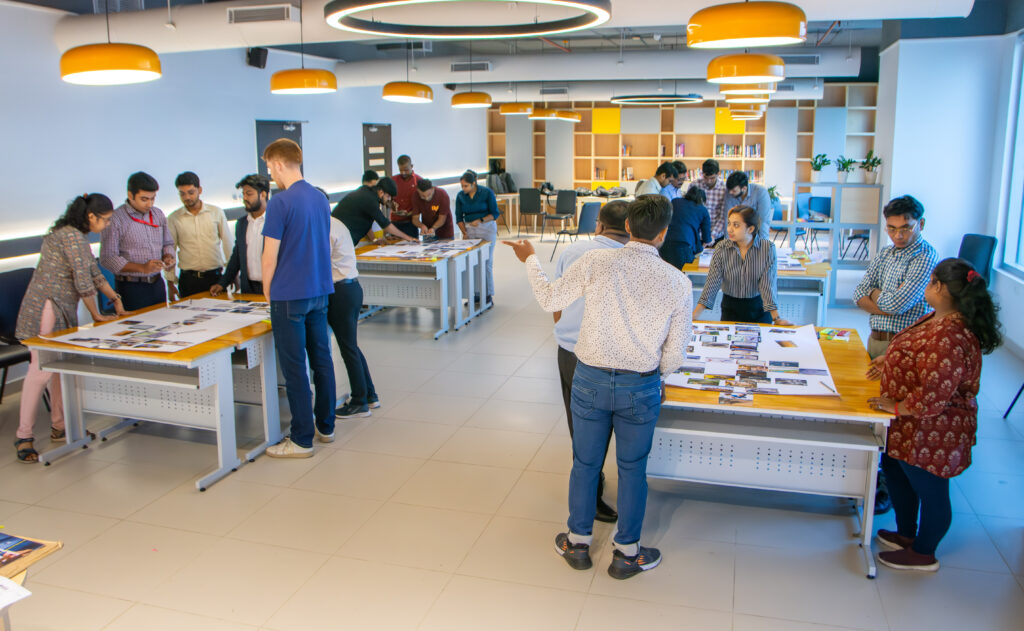
That is why portfolio-based training is crucial. The TIU Joka proposal speaks of field immersions, labs, live projects, community engagement, internships, capstone work and a Sustainability Portfolio or Field Dossier from Year 1 onward. It also proposes practical assessments, viva, external jury, internship evaluation, dashboards, audit reports and stakeholder presentations instead of over-dependence on rote exams.
This is exactly what India needs. Not “notes learners”. But field-ready, tool-ready, communication-ready, industry-ready professionals.
Why Residential Campus Learning Matters
Sustainability cannot be fully learnt in a 10 AM to 4 PM timetable. It needs a 24×7 living lab.
A residential campus can turn every corner into a learning site. The hostel can become a water-use audit site. The canteen can become a waste management lab. The garden can become a biodiversity mapping zone. Energy use can be tracked. Student behaviour can be studied. Composting can be tested. Campaigns can be designed. Field trips can start early. Reflection circles can happen at night. Teams can work beyond classroom hours.
This matters because sustainability is not a subject you “attend”. It is a habit you live.
Residential learning also builds teamwork. CSR and ESG work is never solo work. You work with communities, companies, NGOs, government bodies, auditors, designers, researchers and communicators. A residential campus trains students to collaborate, negotiate, lead, fail, improve and deliver.
India Needs This Now
India is urbanising, industrialising, digitising and climate-stressing at the same time. We need highways, but also clean air. We need factories, but also responsible supply chains. We need jobs, but also safe workplaces. We need cities, but also water security. We need growth, but also justice.
That is why sustainability careers are not a luxury. They are nation-building careers.
For GenZ, this is a rare space where purpose and profession can meet. You can earn, grow, travel, consult, build startups, work with global frameworks and still contribute to society.
TIU Joka: A Useful Launchpad for the Green-Career Generation
TIU Joka can be useful because it is imagined as a residential, practice-rich, interdisciplinary campus where sustainability is not locked inside one department. With its Faculty of Sustainability and Development, its Nexus–Pyramid model, its B.Sc. and B.A. pathways, its CSR-ESG-development connection, its fieldwork, internships, live projects, capstone and portfolio-based evaluation, it can become a serious launchpad for young people who want careers with meaning and market value.
For the student who wants more than a degree, TIU Joka can offer the right space: learn by doing, build by testing, prove through portfolio, and grow into a professional who can work for people, planet and progress.
Because the future will not be won by those who only talk green.
It will be built by those who can make green work.