
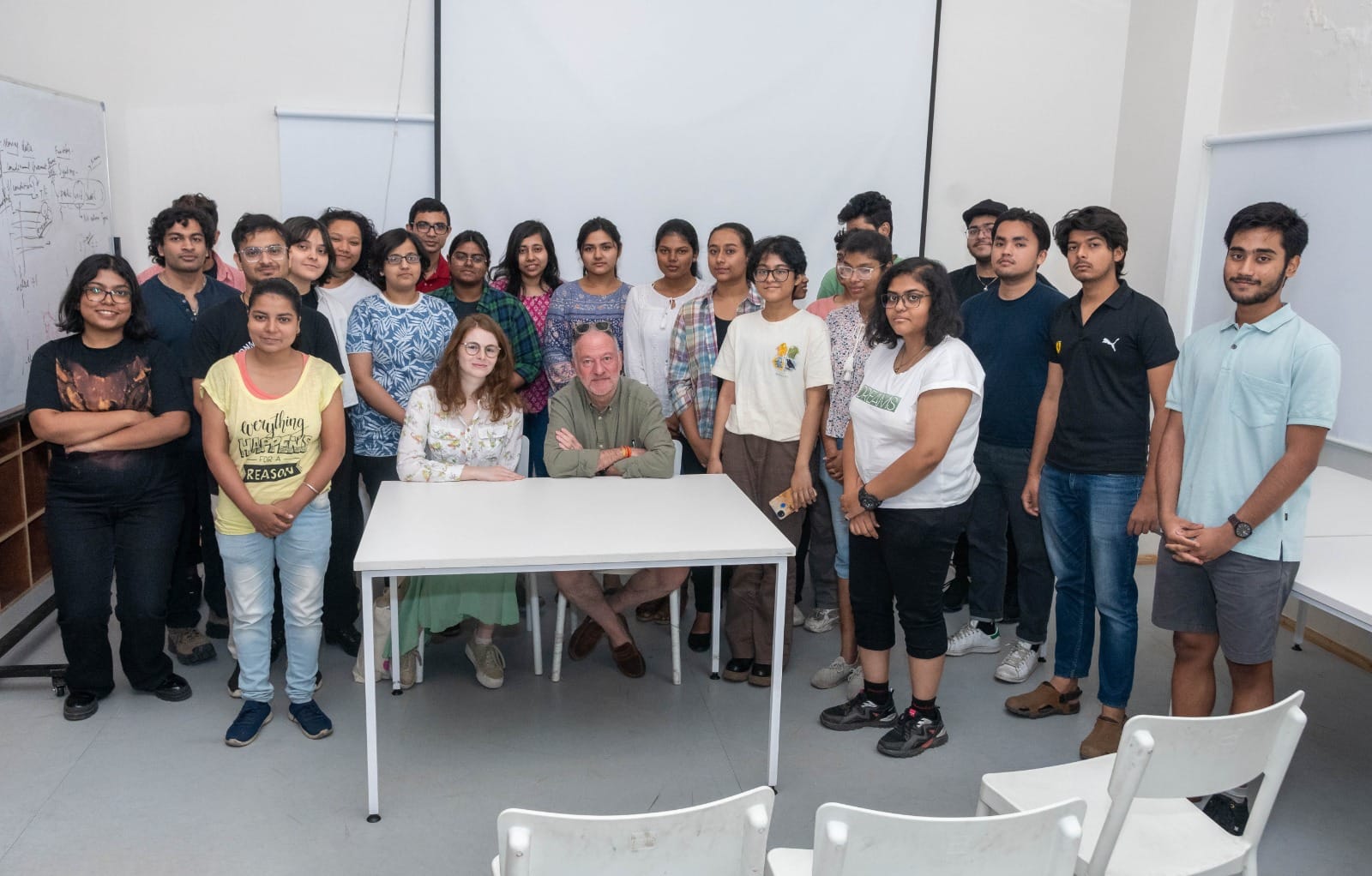
In a world crowded with images, interfaces, brands, motion, and noise, a powerful design career belongs not to the merely talented, but to the deeply observant, relentlessly disciplined, and unmistakably original, writes Prof Ujjwal K Chowdhury.
There is a moment in the life of almost every design aspirant when the dream feels beautifully simple.
You imagine yourself creating striking visuals, building bold brands, shaping memorable campaigns, designing seamless digital experiences, animating worlds, or developing immersive game environments. You see design as freedom, as expression, as a life less ordinary. And that instinct is not wrong. Design is exciting. It is expressive. It is one of the most dynamic professional spaces of our time. But the moment you begin to take it seriously, another truth emerges: a strong design career is not built on excitement alone. It is built on preparation. It is built on discipline. It is built on the courage to turn creativity into craft and aspiration into professional strength.
That is what makes the journey so thrilling. Design is not just a course choice. It is a way of seeing, decoding, questioning, and reshaping the world. It teaches you to notice what others ignore. It trains you to make meaning visible. It asks you not only to create, but to communicate, solve, persuade, provoke, and imagine. And in today’s economy, where brands, apps, films, games, interfaces, campaigns, and social platforms compete for attention every second, that ability has become central, not secondary.
Design Is No Longer Decoration. It Is Direction.
For years, many people misunderstood design. They treated it as surface polish, an afterthought added once the “real” work had been done. That world is gone. Today, design sits at the centre of how people interact with products, services, media, entertainment, and ideas. Every app someone taps, every brand someone remembers, every campaign that persuades, every streaming platform that retains attention, every game that immerses, and every interface that earns trust depends on design thinking.
That means if you are preparing for a design career now, you are not entering a decorative profession. You are entering a strategic one. Designers shape how people feel, click, pause, buy, trust, respond, and return. A strong designer today is part storyteller, part problem-solver, part cultural interpreter, part communicator, and part experience-builder. This is why the field demands seriousness from the beginning. You are not choosing a hobby with career options attached. You are choosing a career path with growing relevance in India and across the world.
Think of the most ordinary day in a student’s life. You unlock your phone. You scroll through social media. You order food. You watch a reel. You browse a shopping site. You stream a show. You notice a campaign. You respond to a logo, a layout, a motion style, a thumbnail, an ad, an interface. In every one of those moments, somebody’s design decision is guiding your attention. The modern world is not merely full of design. It is increasingly run by it.
Your Portfolio Will Introduce You Before You Speak
One of the hardest but most useful truths for young creatives is this: in design, your portfolio often matters more than your percentages. The classroom matters. Learning matters. Critique matters. But when it comes to internships, freelance opportunities, studio placements, agency roles, or creative collaborations, people want proof. They want to see what you have made. They want to know how you think. They want to know whether you can understand a brief, shape an idea, refine an execution, and present work with conviction.
That changes the meaning of student life. Suddenly, assignments are no longer routine submissions. They are raw material for a future career. A poster is not just an exercise. It may become evidence of visual intelligence. A campaign concept may become proof of strategic imagination. A digital interface can demonstrate clarity of thinking. An animation clip can reveal your sense of timing and emotion. A game concept can show narrative instinct and system logic. A typography piece, a branding exercise, a motion experiment, a layout system, a character sketch, a social media campaign prototype — each of these can become a door-opener.
The strongest students understand this early. They do not wait until the final semester to “make a portfolio.” They live inside the process of building one. They save drafts. They revisit work. They polish presentations. They learn how to show process, not just outcomes. They begin to ask a more serious question: not “How do I finish this assignment?” but “Could this become part of the body of work that represents me?”
That is a powerful shift. And careers are often built inside such shifts.
Design Is Not One Road. It Is a Whole Creative City.
Many students begin with a sentence that sounds confident but is actually incomplete: “I want to do design.” That is a good beginning, not a clear destination. Because design is not one profession. It is a family of professions, each with its own rhythms, demands, temperaments, and futures.
If you are drawn to platforms, interfaces, digital behaviour, screen journeys, and user flows, you may find your instinct leaning toward digital design. If you are excited by campaigns, branding, persuasion, audience psychology, and cultural messaging, advertising design may feel like home. If typography, layouts, publications, visual systems, identity, and communication structure fascinate you, visual communication may be your field. If characters, cinematic imagination, motion, timing, sequencing, and visual storytelling pull you in, animation opens a compelling path. And if you are thrilled by interactive worlds, gameplay systems, immersive storytelling, environments, and player experience, game design may be where your imagination comes alive.
The right move is not to rush blindly into the most glamorous label. It is to explore deeply enough to discover where your talent, temperament, curiosity, and market opportunity begin to align. Strong design careers are often built not by following noise, but by identifying fit.
Talent Is Beautiful. Discipline Is What Makes It Professional.
There is a romantic myth that follows many young creative people: “I am talented, so I will do well.” It sounds hopeful. It is also dangerously incomplete. The professional world values creativity, yes. But it values disciplined creativity even more.
Can you work to a deadline? Can you revise without drama? Can you handle critique without collapsing? Can you take a concept through multiple drafts? Can you collaborate? Can you present? Can you remain original without becoming careless? Can you continue showing up on the days when inspiration does not show up first?
These are not side questions. These are career questions.
A powerful design career is built not only on flair, but on process. The strongest students are not always the loudest, the flashiest, or the most instantly impressive. Often, they are the ones who keep refining, keep learning, keep accepting feedback, and keep growing. They understand that professional creativity is not just about having ideas. It is about making ideas work.
In the real world, studios and agencies do not hire potential alone. They hire promise backed by consistency. They hire people who can deliver.
Kolkata Is Not Just a Location. It Can Be Your Design Laboratory.
A young designer can learn from software. A serious designer learns from surroundings. That is why studying in a design college in Kolkata can become a major creative advantage if used intelligently. The source material makes this point sharply, and rightly so: Kolkata is not merely a city in which you attend class. It is itself a living archive of visual culture.
Look closely and the city starts teaching. Tram signs. Book covers. Durga Puja installations. Film posters. Street graphics. Political wall art. Old typography. Theatre culture. Neighbourhood colour palettes. Hand-made signage. Public imagery. Illustration traditions. Layers of nostalgia and modernity existing on the same street. Kolkata carries memory in visible form. It offers texture, contradiction, craft, vernacular intelligence, and cultural density.
A design aspirant who only studies from screens becomes technically aware. A design aspirant who studies the city becomes visually awake.
Imagine a student documenting old shop signs in North Kolkata and translating those typographic rhythms into a branding project. Imagine another drawing inspiration from Durga Puja installation storytelling to think about spatial experience or event graphics. Imagine an animation learner observing local visual humour, gesture, and street theatre to create more rooted characters. Imagine a visual communication student studying the layered language of book covers, political posters, and festival publicity to build stronger editorial instincts. That is how surroundings become substance.
Originality often grows when observation becomes a habit.
Local Roots, Global Eyes
Another powerful thread in the webinar material is the importance of combining local grounding with international exposure. That matters enormously in design education. The global creative world moves quickly. Standards travel. Trends circulate. Visual cultures borrow, remix, and evolve at speed. So the value of learning within a framework that also brings an international design dimension is not just credential-based. It is perspective-based.
The real advantage is not merely that a student has a degree plus another diploma layer attached to it. The deeper advantage is that the learner begins to understand design beyond software instruction. They begin to absorb global benchmarks, conceptual thinking, professional presentation, and broader creative culture while remaining contextually rooted. That combination is powerful. It helps a student avoid two common traps: being locally limited, or globally imitative.
The future belongs to designers who can think globally without becoming generic.
The Most Employable Designers Will Be Hybrid Thinkers
The design world is no longer neatly divided. The old logic of one skill, one role, one lane is weakening fast. A visual communication student may work in branding, content design, digital publishing, motion assets, and campaign systems. A digital design learner may move across interfaces, user journeys, content structures, and brand ecosystems. An animation student may work in OTT content, advertising films, educational storytelling, immersive installations, or entertainment media. A game design aspirant may work across narrative, concept art, experience design, environment thinking, interaction, and community-facing engagement.
This means the future designer must be both specialised and adaptable. Depth still matters. But so does range. The strongest careers are increasingly being built by people who know one area deeply and can speak across adjacent ones intelligently. A hybrid designer is often more resilient, more employable, and more future-ready.
In practical terms, that means a student should not think only in terms of narrow job titles. The better question is: what creative ecosystem am I preparing myself to thrive inside?
Technology Will Keep Changing. Your Thinking Must Grow Deeper Than the Tool.
AI is here. Automation is here. Faster rendering is here. Smarter motion tools are here. Content generation is getting quicker. Workflows are changing. Design software will continue to evolve. The webinar material addresses this directly and wisely: students should neither fear technology nor worship it blindly.
That is exactly the right attitude.
Tools can generate. Designers must still decide. Tools can accelerate. Designers must still interpret. Tools can multiply options. Designers must still choose what matters. Human imagination, judgment, ethics, taste, storytelling, cultural sensitivity, and originality remain central. In fact, as tools become faster, the value of strong thinking often becomes even more visible.
A young designer should absolutely learn new systems, experiment with emerging platforms, and stay curious. But none of that should come at the cost of fundamentals. Design thinking, composition, hierarchy, storytelling, structure, concept development, and communication are not outdated by the arrival of better software. They travel with you when every tool changes.
The future will not belong to the student who only knows buttons. It will belong to the one who knows why something should exist, how it should work, what it should feel like, and why someone should care.
If You Cannot Explain the Work, You Limit the Work
Many promising young creatives lose ground not because their ideas are weak, but because their articulation is weak. They can make work, but they cannot explain it. They can design, but they cannot defend design choices. In the real world, that becomes a problem very quickly.
You will need to present to faculty. To juries. To studios. To agencies. To collaborators. To clients. To recruiters. You will need to explain why a visual language fits a brief, why a certain layout creates clarity, why a campaign idea has strategic value, why a motion sequence works emotionally, why a game mechanic supports player experience. If your words fail, your work may lose force even when the idea is strong.
That is why communication is not an optional extra in design education. It is a professional asset. Vocabulary, confidence, critique ability, observation language, and presentation skill all matter. A designer who can think sharply and speak clearly gains a major advantage.
The Real Goal Is Not Just a Job. It Is a Creative Identity.
In the end, perhaps the deepest insight in the source material is also the most lasting one: design education should help you discover not only a career, but a creative identity.
What kind of designer do you want to become? Strategic or expressive? Minimal or bold? Cultural or commercial? Motion-led or concept-led? Interface-driven or story-driven? Experimental or brand-focused? Those are not abstract questions. Over time, they shape your style, your choices, your portfolio, your opportunities, and your place in the industry.
The most memorable designers are not merely trained. They are formed. They develop a point of view. They build taste. They cultivate method. They learn what they stand for visually, conceptually, and professionally. That formation begins during the student years, often quietly, through repeated choices: what you observe, what you make, what you reject, what you revise, and what you keep returning to.
Begin Before the Career Officially Begins
A design career does not begin on the day you receive your first offer letter. It begins on the day you start seeing differently. On the day you begin to observe with intent. On the day you stop treating creativity casually. On the day you decide that your imagination deserves discipline and your talent deserves structure.
That is the real invitation before every design aspirant.
Come ready to observe.
Come ready to experiment.
Come ready to be corrected.
Come ready to build.
Come ready to struggle intelligently.
Come ready to sharpen your taste.
Come ready to discover your voice.
Because a strong design career is not built by accident. It is built by attention, effort, resilience, curiosity, and depth. And the students who understand that early, like the Ecole Intuit Lab students, do not just enter the design world. They begin to shape it.
Author is the Pro Vice Chancellor of Techno India University, and a senior academic from the field of media and design, being earlier the Dean of Symbiosis, Amity, Adamas Universities & Pearl Academy